
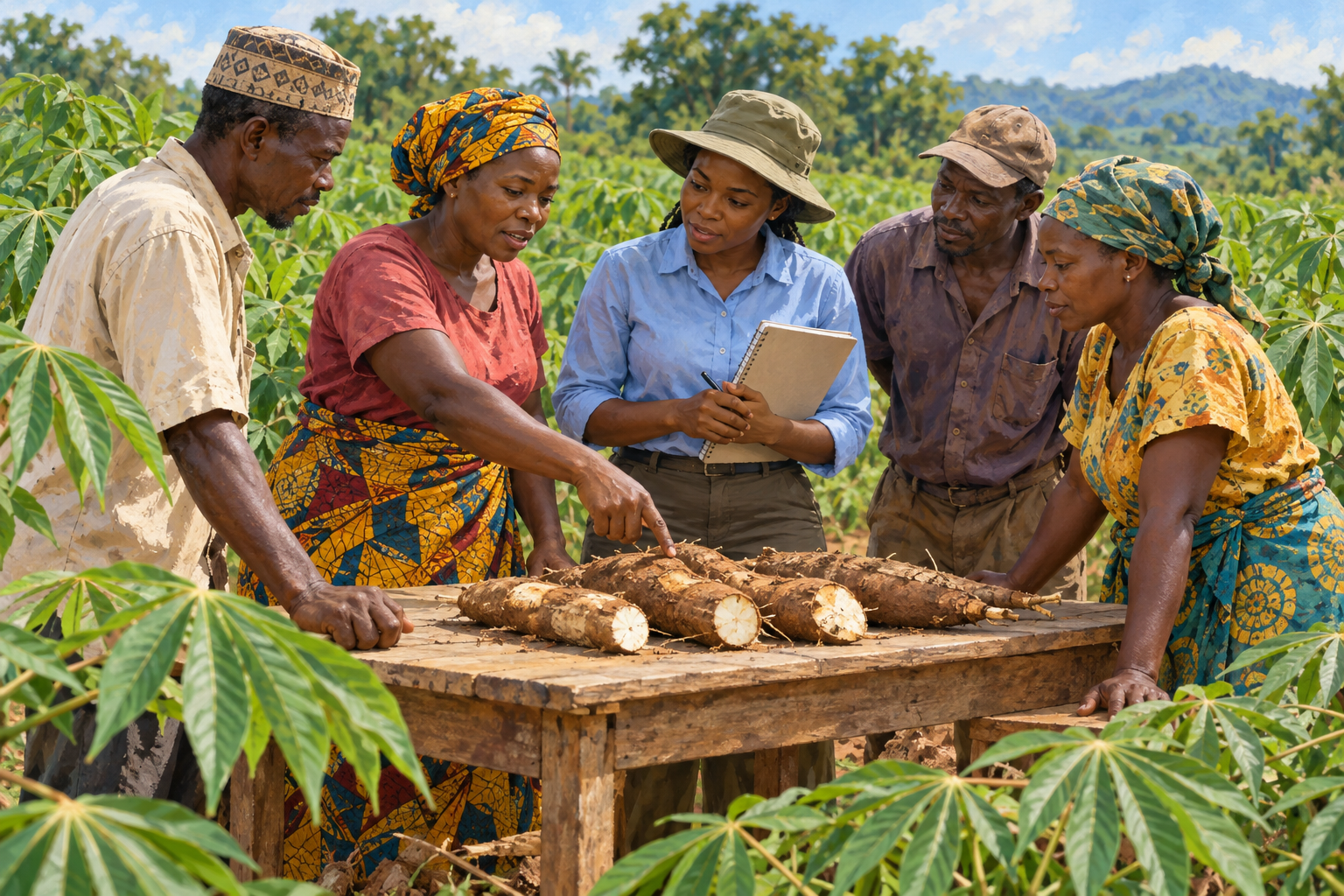
AI-generated illustration; not a photograph of the Epe trial or its participants.
At a field day in Epe, Lagos State, farmers gathered to help answer a practical question: which cassava varieties would work best for their farms—and for the people buying their harvest?
They looked beyond the size of the roots. They considered how well plants stood, the products processors could make from them, and whether the varieties suited their everyday needs.
IITA reported the trial on 11 September 2026. It involved 92 smallholder farmers and commercial cassava seed entrepreneurs, including 47 women.
Farmers help choose
The trial brought together the International Institute of Tropical Agriculture (IITA), Sasakawa Africa and participants in the PROSSIVA project, which works to improve access to cassava planting materials.
At IFGREEN Industries, participants compared three varieties: Baba 70, Renewed Hope and TME419.
They examined harvested roots, fresh weight, plant structure and other characteristics. More than 90 per cent preferred Baba 70 and Renewed Hope. Participants also considered these two varieties less likely to fall over in heavy winds.
For farmers, these details matter. Choosing a variety means thinking about what will grow well, withstand difficult conditions and produce a harvest worth selling.
The field day gave them a place in that decision, alongside researchers and seed entrepreneurs.
Connecting farms with markets
Growing cassava is only one part of the journey. The roots must also meet the needs of processors making foods such as garri, fufu and cassava flour.
IFGREEN tested the harvested roots for different products. Baba 70 was preferred for garri quality. Renewed Hope produced the greatest quantity of garri and performed well for high-quality cassava flour. TME419 was preferred for its bright white colour.
There was no single winner for every purpose.
Instead, the results showed why farmers, seed suppliers and processors benefit from working together. Understanding what buyers need can help guide decisions about which varieties to grow and supply.
Learning from one another
For participant Josephine Idowu, the field day offered more than a comparison of plants.
She described an opportunity to learn about improved varieties and processing, meet people across the cassava industry and build knowledge to support her agricultural business. She hoped to put that learning into practice.
Her experience reflects the human value of the event: practical information becomes more useful when people also have opportunities to exchange ideas and make connections.
A hopeful step forward
This was a trial, rather than proof that participating farmers had already increased their incomes. Wider access to planting materials and sustained adoption remain important next steps.
But the approach offers a hopeful example of research shaped by the people who will use it.
In Epe, farmers were helping find answers that could work for both their land and their market.
Source: IITA, September 2026. https: //blogs.iita.org/farmers-test-cassava-varieties-for-better-markets/
Leave a Reply