
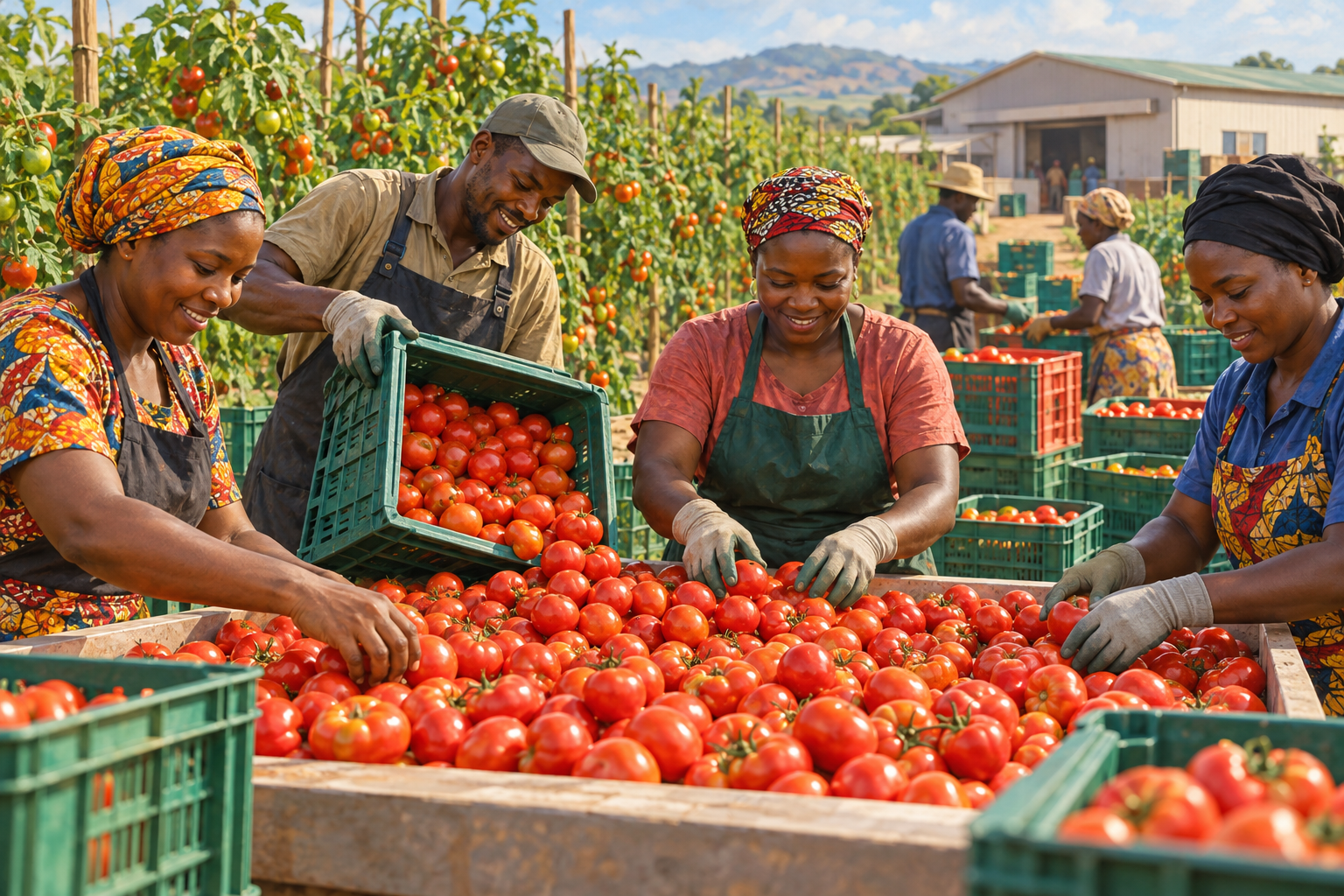
AI-generated illustration of tomato farming; not a photograph of Tomato Jos, its staff or premises.
Before Tomato Jos became a food business, it was a question that stayed with Mira Mehta.
While living and working in Nigeria, she saw tomatoes rotting beside the road. Farmers were growing food, yet some of their harvest was failing to reach a useful market.
Why couldn’t more of those tomatoes become tomato paste made locally?
That question eventually became a business. In 2014, Mira and co-founder Shane Kiernan launched Tomato Jos, linking an entrepreneurial idea with an ambition to help smallholder farmers build more profitable livelihoods.
The journey took patience. The company’s account of its early years describes crop disease and water shortages among the challenges it faced. Growing suitable tomatoes and building a dependable supply chain required more than enthusiasm.
From its first farming operations in Nasarawa State, the team began putting its idea into practice: support farmers during the growing season, then turn their harvest into a product for Nigerian consumers.
Today, Tomato Jos operates a farming and processing business in Kaduna State, producing packaged tomato paste for the domestic market.
Women are an important part of that story. In an investment announcement published by AVCA, Sabou Capital reported that women represented 60% of the company’s smallholder suppliers. Behind the finished product is a network of people whose work begins long before the tomatoes reach the factory.
A recent development marks another step forward.
On 22 September 2026, EDFI Management Company announced a $2.5 million AgriFI investment in Tomato Jos. The financing will support packaging equipment, factory upgrades and expanded drip irrigation.
According to the announcement, more than half of the company’s raw materials come from local smallholder farmers. The planned improvements aim to reduce production costs, broaden its products and deepen its work with farming communities. These are plans for the next stage of growth, rather than results already achieved.
Mira’s journey shows how an observation can grow into years of practical work. Tomatoes beside a road prompted a question. Building an answer brought together farmers, a processing business and a market for locally made food.
For MyHappyAfrica, that is a story of progress worth sharing: people finding opportunity in what their communities already produce, and working to make that opportunity last.
Sources: Tomato Jos; The Harvard Crimson; AVCA/Sabou Capital; EDFI Management Company (22 September 2026).
Leave a Reply