
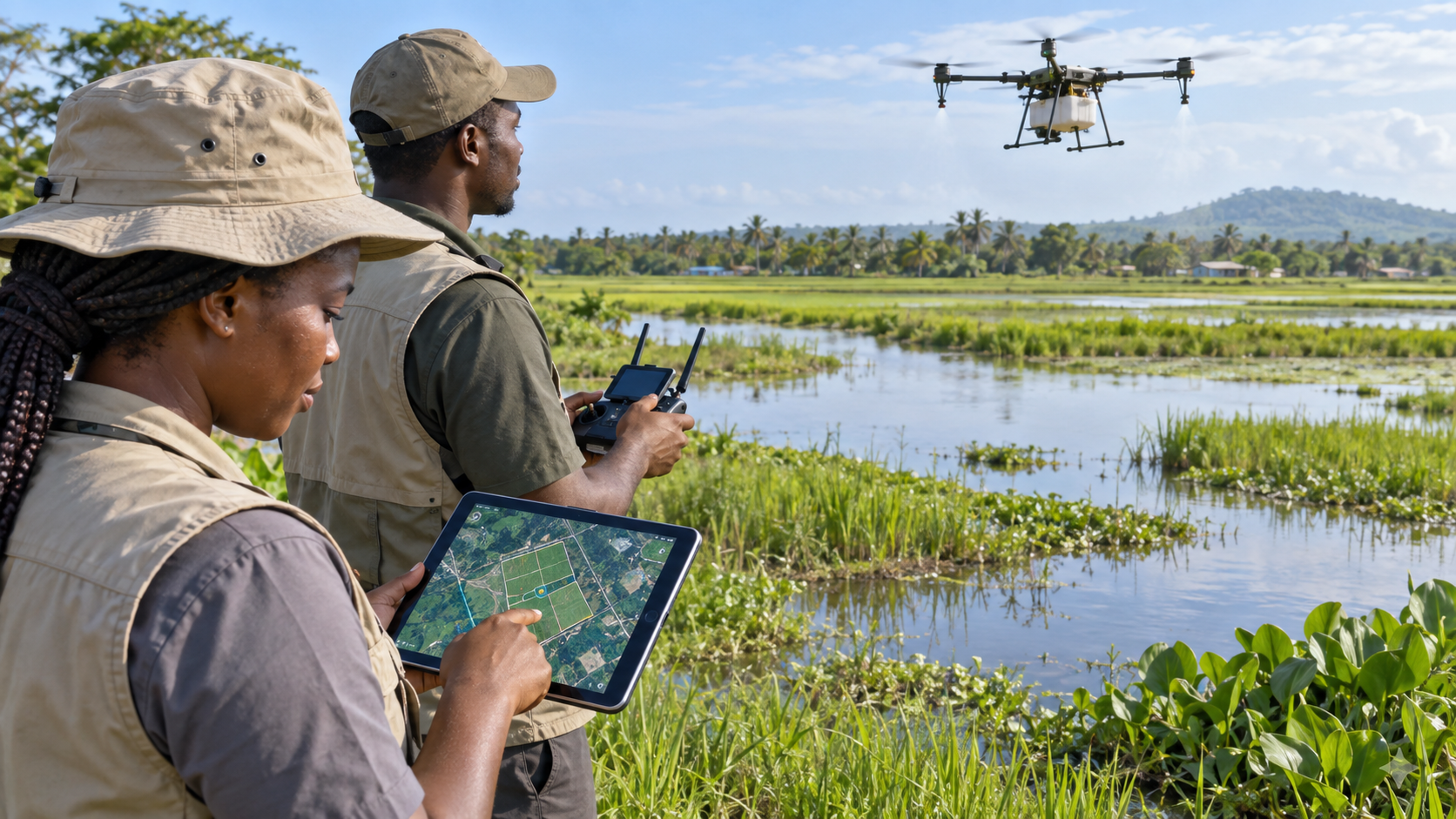
In Ghana’s Ada East District, researchers are testing how drones, artificial intelligence and digital mapping can improve malaria prevention in hard-to-reach communities.
Wetlands, lagoons and rice fields in the district create favourable conditions for mosquitoes to breed. Finding and treating these areas using conventional methods can be extremely time-consuming. According to the project team, two workers may need up to 10 days to cover just one kilometre of mosquito-breeding habitats.
The new approach uses drones to map the landscape, while AI-assisted analysis helps identify places where mosquitoes may be breeding. The drones can then spray larvicide on the mapped locations in under an hour—a task that could take field workers several days using conventional methods.
The pilot study brings together Ghana’s National Malaria Elimination Programme, UNDP’s Access and Delivery Partnership, SORA Technology and the WHO-supported TDR programme. Their goal is to discover whether this technology can strengthen routine malaria prevention in Ghana and other hard-to-reach settings.
This is what positive change looks like: African health experts combining local knowledge with modern technology to protect communities, save time and make malaria prevention more effective.
Original source: WHO/TDR – Harnessing drones and AI to combat malaria in Ghana
Leave a Reply